Machu Pichu Peru
THE DISCOVERY
The ruins of Machu Pichu,
rediscovered in 1911 by Yale archaeologist Hiram Bingham, are one of the
most beautiful and enigmatic ancient sites in the world. While the Inca
people utilized the Andean mountain top (9060 feet elevation), erecting
massive stone structures from the early 1400's, legends and myths
indicate that Machu Pichu (meaning 'Old Peak' in the Quechua language)
was revered as a sacred place from a far earlier time. Whatever its
origins, the Inca turned the site into a small (5 square miles) but
extraordinary city. Invisible from below and completely self-contained,
surrounded by agricultural terraces sufficient to feed the population,
and watered by natural springs, Machu Pichu seems to have been utilized
by the Inca as a secret ceremonial city. Two thousand feet above the
rumbling Urubamba river, the cloud shrouded ruins have palaces, baths,
temples, storage rooms and some 150 houses, all in a remarkable state of
preservation. These structures, carved from the gray granite of the
mountain top are wonders of both architectural and aesthetic genius.
Many of the building blocks weigh 50 tons or more yet they are sculpted
so precisely and fitted together with such exactitude that the mortar less
joints will not permit the insertion of even a thin knife blade. Little
is known of the social or religious use of the site, yet the skeletal
remains of ten females to one male suggests that it may have been a
sanctuary for the training of priestesses and /or brides for the Inca
nobility..
One of Machu Pichu's primary functions was that of astronomical observatory. The Intihuatana stone (meaning 'Hitching Post of the Sun') has been shown to be a precise indicator of the date of the winter solstice and other significant celestial periods. Every midwinter, the Incas held a ceremony at this stone, in which they 'tied the sun' to halt its northward movement in the sky. Shamanic legends say that when sensitive persons touch their foreheads to the stone, the Intihuatana opens one's vision to the spirit world (the author had such an experience which is described in detail in chapter one). Intihuatana stones were the supremely sacred objects of the Inca people and were systematically searched for and destroyed by the Spaniards. When the Intihuatana stone was broken at an Inca shrine, the Inca believed that the deities of the place died or departed. The Spaniards never found Machu Pichu, even though they suspected its existence, thus the Intihuatana stone and its resident spirits remain in their original position. The mountain top sanctuary fell into disuse and was abandoned some forty years after the Spanish took Cuzco in 1533. Supply lines linking the many Inca social centers were disrupted and the great empire came to an end.
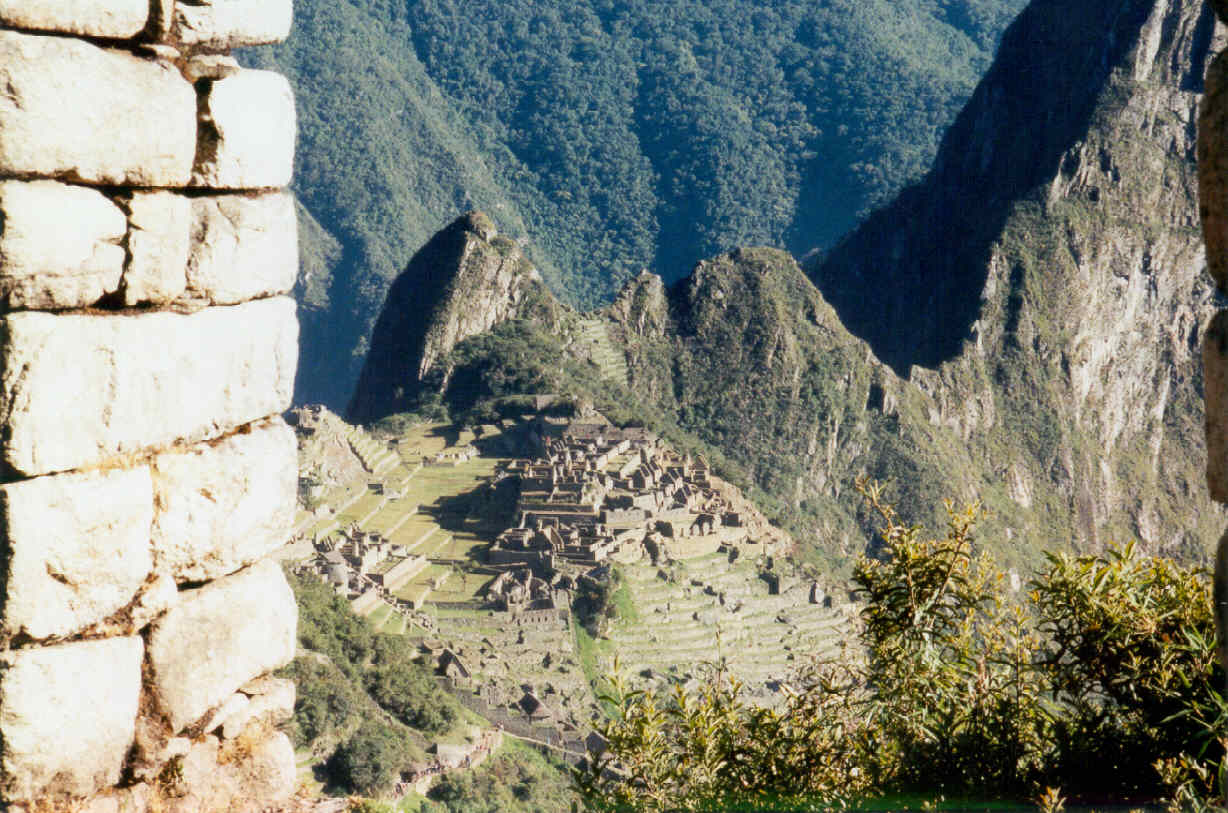
"Inti Punku" or Gate to the sun. From here we first see the spectacular city of Machu Picchu below us. A quick descent along the wide royal Inca road and we enter the mysterious citadel to spend some time wandering and wondering in the midst of its eternal beauty. We walked the Inca trail from Machu Picchu to the Sun Gate and took this picture.
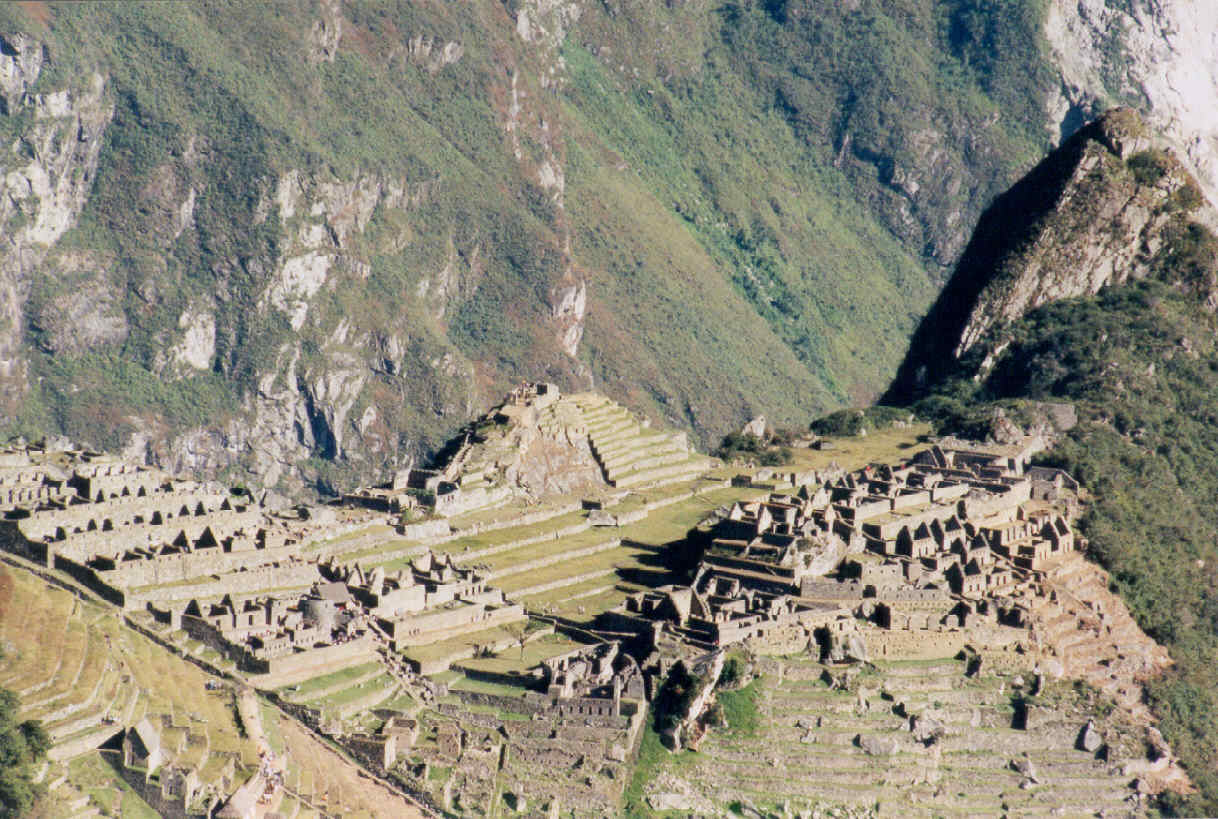
Using a 300mm zoom lens we took this picture of Machu Picchu from the Sun Gate. The agricultural terraces are on the left and bottom, while the religious area of Machu Pichu is on the right.
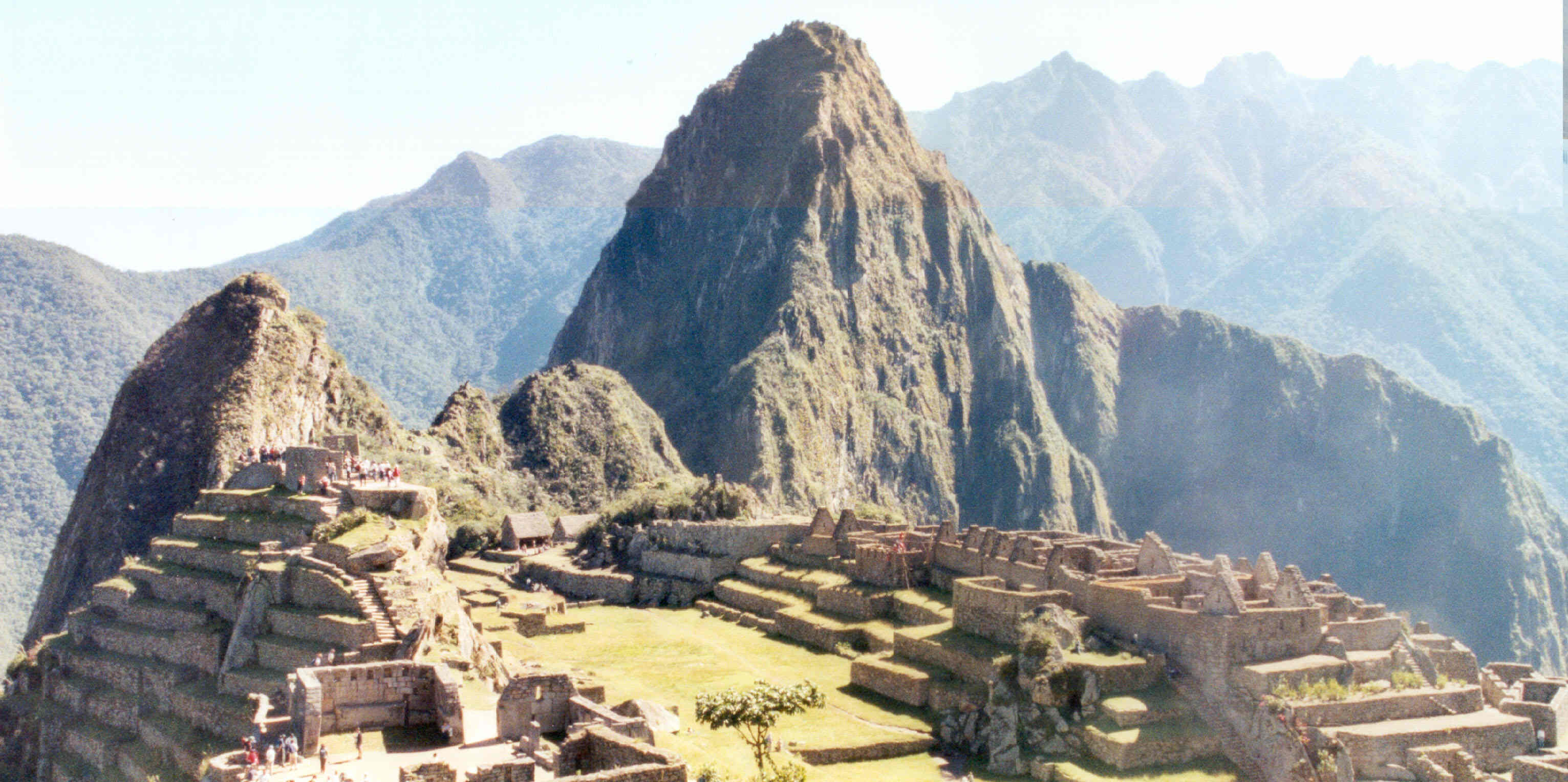
A panoramic picture of Machu Picchu from an agricultural Terrace.